Clap Country: A Field Guide to Britain's Strangest Standing Ovations
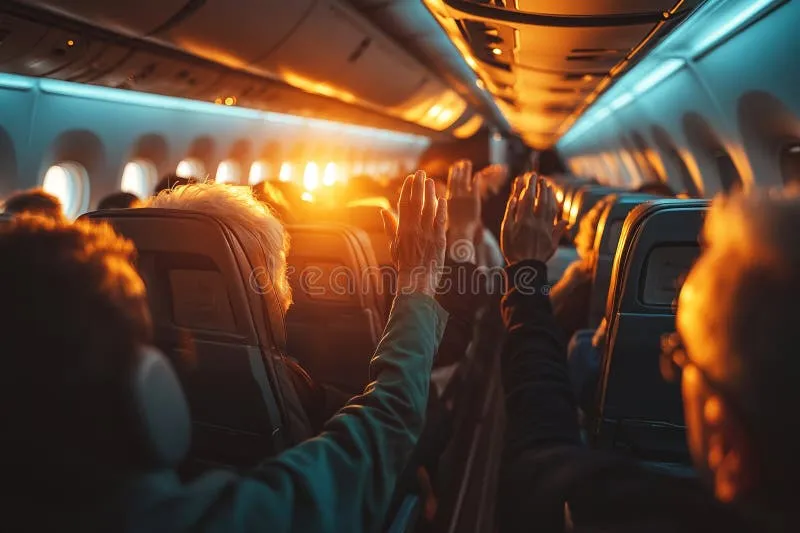
Photo: passengers applauding airplane cabin landing, via thumbs.dreamstime.com
There is a moment on every Ryanair flight to Palma where something remarkable happens. The plane touches down. The wheels squeal. And somewhere behind you — always behind you, never in front — a pair of hands begins to come together, and a hundred strangers must each make a decision that will define them forever: clap, or don't.
We are told Britain is a nation of emotional repression. This is a lie. Britain is a nation of emotional expression under extremely specific conditions, and those conditions are governed by a clapping code so intricate that no one has ever written it down. Until now, obviously. You're welcome.
The Aeroplane Applause: A Taxonomy
First, let's be clear: the landing clap is not universal. It is situational. There is a complex matrix at play, and every British passenger is running the calculations before the seatbelt sign is even off.
Did the plane land during a storm? Clap is mandatory. Did the pilot announce a rough approach? Applause is now a civic duty. Was the flight uneventful, the landing smooth, the skies calm? Then clapping is, frankly, unhinged behaviour and you will be quietly judged by row fourteen.
The exception, of course, is any flight arriving in Poland, Ireland, or Portugal, where the clap appears to be contractually obliged regardless of conditions. British holidaymakers understand this instinctively. We see a Ryanair flight touching down in Kraków and we think: ah yes, the ancient rules apply here. We comply. We are guests.
The Bus Stop Protocol
Then there's the 'cheers driver', which is not a clap at all but a related ritual in the wider family of British acknowledgement ceremonies. Note the rules: you say it as you exit, never as you enter. You make eye contact if brave, or you say it to the general direction of the windscreen if not. If the driver has done literally anything — waited three seconds for a woman with a pram, say — the phrase upgrades to 'cheers very much', and a bond is formed that will never be spoken of again.
My grandfather said 'cheers driver' to the number 43 for forty years. When he died, three bus drivers came to the funeral. This is not a joke. This is the actual social fabric of this country, woven one gruff two-word transaction at a time.
The Golf Murmur
Perhaps the most refined of all our applause formats is the pub golf murmur. When someone sinks a long putt on the telly, the pub does not erupt. It produces a sound I can only describe as a collective 'ooh' followed by a low 'go on, yes' — a noise that registers on seismographs but not in any official capacity. It is applause in stealth mode. Applause that has been asked to keep its voice down.
Compare this to our darts crowds, where grown men in fancy dress scream like the building is on fire, and you'll understand that the British clap spectrum runs from a whispered 'ooh' to a man dressed as a banana bellowing 'ONE HUNDRED AND EIGHTY'. We contain multitudes. Loud, beery multitudes.
Where Did It All Come From?
Nobody knows. That's the beauty of it. The landing clap has been attributed to everything from wartime nerves to Eastern European tradition to simple relief at not dying over the Bay of Biscay. The truth is it doesn't matter. These rituals weren't designed. They evolved, like the roundabout, like queueing, like apologising to furniture.
What matters is that they work. The landing clap says: we were all briefly terrified together, and now we're alive, and that's worth thirty pairs of hands. The 'cheers driver' says: I see you, doing your job, in the rain, and I acknowledge it. The golf murmur says: I am moved, but I'm also holding a pint.
Our True National Language
We don't clap because we're impressed. We clap because the alternative is saying something sincere out loud, and let's not be ridiculous.
The British applause index is, in the end, a complete emotional vocabulary for people who'd rather chew glass than have a feeling in public. It's gratitude, relief, awe and love, compressed into a noise you can make without making eye contact.
Foreign visitors find it baffling. Good. Let them. Some things must remain mysterious, like the offside rule, and why we queue for a bus that is clearly already full.
So next time the wheels touch down and someone behind you starts that slow, hopeful clapping — join in. Or don't. But know that either way, you're speaking fluent British.
Cheers, driver.